
Original bronze sculpture MONTECARLO GTB CENTENAIRE
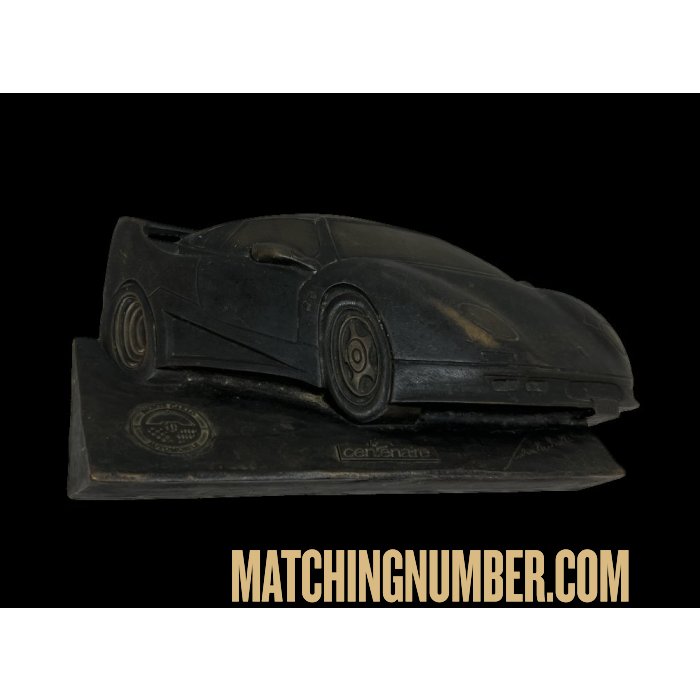
Original piece from manufacturer
Categories:
Memorabilia e documentazione tecnica
/
Opere d'arte
/
Manufacturer:
MONTECARLO GTB CENTENAIRE
Part status:
Used
$1,044.00
Taxes and purchase protection included
Taxes and purchase protection included
Indicative exchange rate, may be charged in EUR depending on payment method.
Description
The Montecarlo GTB Centenaire is a luxury sports car from the Monegasque manufacturer Monte Carlo Automobile (MCA). To date, it is the only car produced by the eponymous manufacturer, excluding the Ala 50 prototype, and it is also the only car produced by a Monegasque manufacturer. The idea for the GTB was born in 1983, the year the company was founded, when the owner and founder of the company, Fulvio Maria Ballabio, decided to create a new luxury car manufacturer to celebrate the centenary of the Automobile Club of Monaco, founded in 1890. The prototype was completed in 1989 and tested several times on the track by Ballabio himself; in 1990, on the occasion of the centenary of the Automobile Club of Monaco, it was donated to Prince Rainier III by Monaco. The original plan called for the construction of one hundred examples, but in the end only five were built: one belonged to Prince Rainier, one was painted black, one red, one white, and two blue. One of these examples (one of the two blue ones) was a Targa version, with a removable Targa roof and, unlike the standard GTB, no rear wing. Only one example of this version exists, and its name is not GTB Centenaire, but Beau Rivage, after the famous corner on the Monte Carlo circuit. The second factor that significantly influenced the price, in addition to the very limited number of examples produced, was the fact that its construction largely used futuristic materials, which were much lighter than the metal alloys used until then but with similar strength characteristics. However, these new technologies proved significantly more expensive, precisely because they were not widespread, but were limited to specific sectors of application such as aerospace, aviation, and Formula 1 racing. Chiti boasted considerable experience, so much so that he designed several Ferrari Formula 1 cars that won the world championship and for several years was technical director of the Alfa Romeo racing department, for which he ensured several world championships in the sports prototype sector. Chiti was joined by another designer, Guglielmo Bellasi, who already had some experience in the sector, having also competed in Formula 1. Ballabio managed to reach an agreement with Lamborghini to install the Sant'Agata Bolognese-based manufacturer's engines in his cars, as it was impossible to design an entirely new engine. Lamborghini granted him the license to use the Countach's 5.0-liter twelve-cylinder engine. However, the owner of MCA decided that his car needed to offer even more power than the original engine to reach the top of its class and be the most powerful on the market. Chiti decided to redesign the Countach's engine, converting the V12 from naturally aspirated to supercharged and equipping it with two turbochargers, one for each in-line cylinder; this increased power from the initial 455 hp to 720 hp. Thanks to these improvements, the GTB Centenaire boasted the most powerful engine available on a road car, and only in 1993 did someone do better: the 730 hp Dauer 962 Le Mans. The engine transmitted power to the rear wheels via a 5-speed manual gearbox. In total, five years of design and development were needed to achieve a chassis that guaranteed adequate torsional and bending rigidity for the engine. The latter was mounted mid-rear, allowing for optimal distribution of the concentrated masses in the center of the chassis. For the chassis, they chose to use Kevlar and carbon fiber with a honeycomb structure as the monocoque. To complete the work, the three engineers also decided to use a typical F1 single-seater suspension configuration: a low push-rod wishbone with an anti-roll bar. The aerodynamic profile, which was sharp, was also very interesting; The car appeared very rounded and curved, but its lines were very harmonious, which is why its fluid dynamic performance was quite high. Seen in profile, it had a wedge shape, typical of the cars from which it descended, the Lamborghinis. The very thin nose, facing the asphalt, gave it an excellent aerodynamic drag coefficient. In 1993, Georgian Aleksander Mirianachvizi purchased the rights that MCA held to the Centenaire and renamed it MIG (Migrelia & Georgia). However, the goal was not to continue building it as a road car, but to compete in the 24 Hours of Le Mans with the Automotive Mig Tako team. The engine was replaced with a turbocharged V12 from Motori Moderni, but with disappointing results. The car, renamed the MiG M100, was piloted by Giampiero "Peo" Consonni (who, among other things, oversaw its preparation), Pierre Honegger, Alfonso Orleans de Bourbon, and Aleksandre Mirianachvizi. They qualified thirtieth, about a minute and a half behind the fastest car, the Peugeot 905, and the car did not take part in the race. The only race it participated in was the 6 Hours of Vallelunga, where it finished 23rd.
Merchant:
Seller Pro 315
Do you need more information about the product?
Click on the button for any questions and fill out the form, we will contact you back shortly to address your question!
Do you need more information about the product?
Click on the button for any questions and fill out the form, we will contact you back shortly to address your question!
You might also be interested in


Original piece from manufacturer
$4,872.00


Original piece from manufacturer

Login and Registration Form
Social Login
Login with Your Social Profile Login withSocial Login
Login with Your Social Profile Login with